
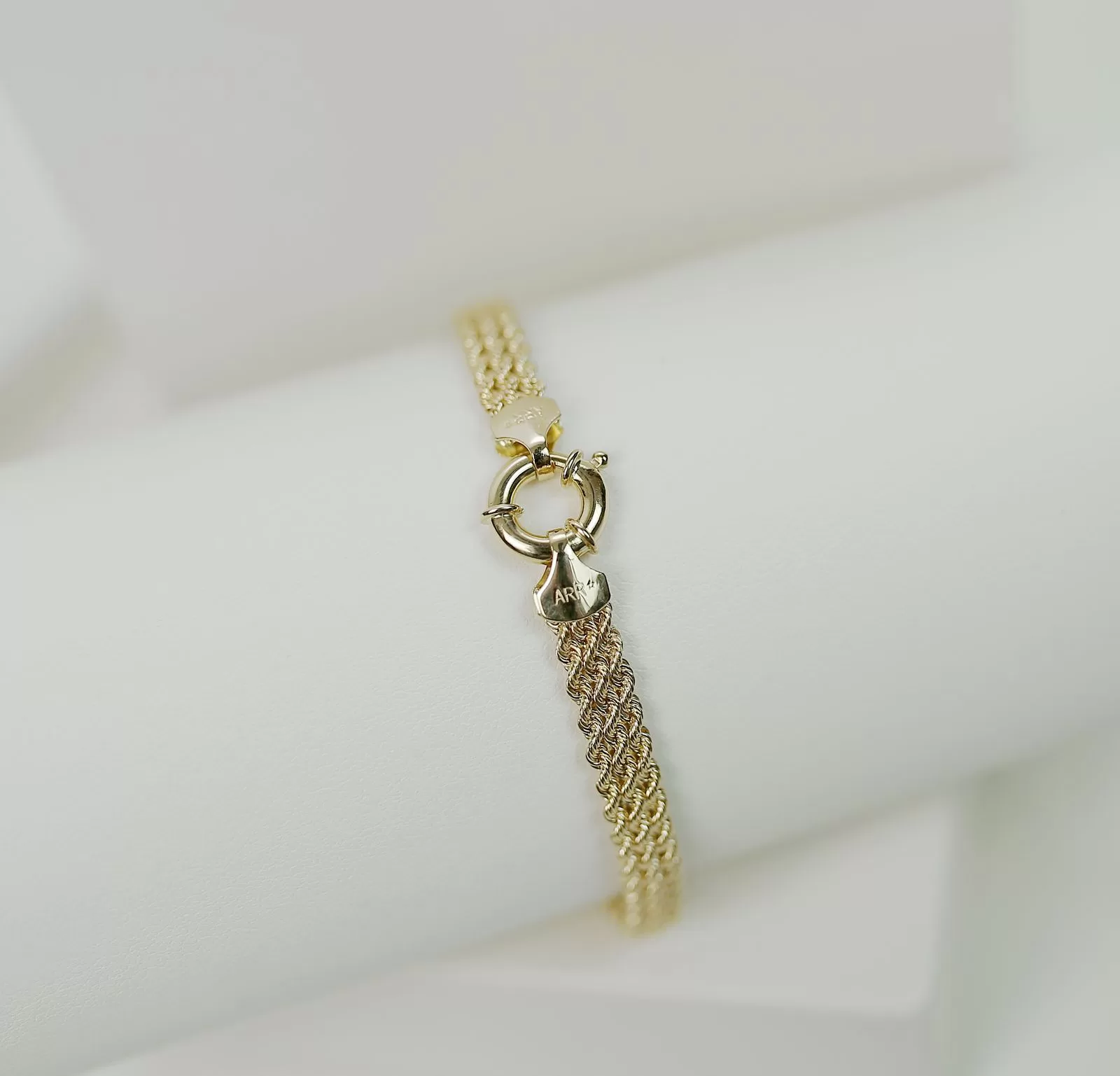

Tiny letters and numbers near the clasp of a Cuban link chain can tell you a lot. They indicate the purity of the gold, whether the chain is plated or filled, and sometimes who made it and where. Learning to read these marks takes a few minutes and makes every chain you look at easier to understand.
Where to find the stamp
On most Cuban links, the stamp is in one of these places:
- On the side or back of the box clasp.
- On the tongue of the clasp.
- On a small flat tag soldered near the clasp.
- On the end link next to the clasp.
Marks are small, so use a jeweler’s loupe or your phone’s camera zoom in good light. Clean the area gently first if it is dirty.
Karat marks
These state the karat directly:
- 10K or 10KT: 10 karat, about 41.7% gold.
- 14K or 14KT: 14 karat, about 58.5% gold.
- 18K or 18KT: 18 karat, 75% gold.
- 22K: about 91.6% gold.
- 24K: about 99.9% gold.
Karat marks are common on chains made for the United States market.
Fineness (millesimal) marks
Many countries use numbers that show gold content in parts per thousand:
| Mark | Equivalent | Gold content |
|---|---|---|
| 375 | 9K | 37.5% |
| 417 | 10K | 41.7% |
| 585 | 14K | 58.5% |
| 750 | 18K | 75.0% |
| 916 | 22K | 91.6% |
| 999 | 24K | 99.9% |
Italian, European and many Asian chains commonly use these numbers. A chain stamped 585 is the same purity as one stamped 14K.
Marks that mean “not solid gold”
- GP: gold plated.
- GEP: gold electroplated.
- HGE or HGP: heavy gold electroplate, a thicker plating, but still plating.
- RGP: rolled gold plate, a thin bonded layer.
- GF or 1/20 GF: gold filled, a thick bonded layer over a base metal.
- 14K GP or 18K GP: plated with 14K or 18K gold; the chain itself is not that karat.
Be careful with marks like “14K GP”: they can be misread quickly as solid 14K.
Silver marks on gold-colored chains
If a gold-colored Cuban link is stamped 925 or Sterling, it is sterling silver, usually with gold plating or vermeil. This is common for affordable wide Cuban links. It is a genuine precious metal base, but not solid gold.
Stainless steel marks
Stainless steel chains are often stamped 316L or Stainless Steel. A gold-colored chain with this mark is gold-tone coated steel.
Maker’s marks
Many chains also carry a maker’s mark: initials, a logo or a code that identifies the manufacturer. In some countries, these are registered and traceable. A maker’s mark is a sign of a more established manufacturer, but on its own it does not guarantee purity.
Country and assay marks
Some countries have official hallmarking systems where an independent assay office tests the metal and applies a mark. The United Kingdom, for example, uses a set of marks including a fineness number, an assay office symbol and a sponsor’s mark. Chains with official assay hallmarks have been independently tested, which gives a higher level of confidence.
The United States does not have mandatory independent hallmarking. Federal rules require that a karat mark be accurate within set tolerances and that a stamped item also carry a trademark of the company that stands behind it, but marks are applied by manufacturers rather than an assay office.
Italian marks
Italy is a major producer of gold chains. Italian gold is often stamped with the fineness (such as 750) plus a code made of a number and a province abbreviation, such as “123 AR” for Arezzo or “456 VI” for Vicenza, which identifies the registered maker. You may also see “Italy” stamped on the clasp.
What if there is no stamp?
A missing stamp does not automatically mean a chain is fake. Possible reasons include:
- The chain is old and the stamp has worn off.
- The chain is handmade by a local jeweler who did not stamp it.
- The clasp was replaced at some point.
- It was made for a market where stamping is not required.
Unstamped chains should be tested before you buy or sell them. A jeweler can do this quickly with an acid test, electronic tester or XRF analyzer.
Can stamps be faked?
Yes. A stamp is simply a mark pressed into the metal, and counterfeiters can stamp “14K” on brass. Signs of a suspicious stamp include uneven, shallow or blurry characters, a stamp that does not match the weight and price of the chain, or a karat stamp on a chain that sticks to a magnet. When in doubt, test.
Stamps on the clasp versus the chain
Sometimes only the clasp is stamped. If a chain has been repaired, the clasp may be a different karat from the chain. A reputable seller should confirm that both are the same metal. If the clasp is stamped and the chain is not, you can ask a jeweler to test a link as well.
Quick summary
- 10K/417, 14K/585 and 18K/750 indicate solid gold of that purity.
- GP, GEP, HGE, RGP and GF indicate plating or filled gold.
- 925 means sterling silver; 316L means stainless steel.
- Maker’s and assay marks add confidence but are not proof on their own.
- No stamp or a doubtful stamp means get it tested.
Shopping for a chain?
Compare current prices, weights and reviews for jewelry loupe options on Amazon. Always check the stated karat, construction and gram weight before you buy.
Frequently asked questions
What does 585 mean on a gold chain?
It means the alloy is 585 parts per thousand pure gold, which is 14K.
What does 750 mean on a gold chain?
It means 75% pure gold, which is 18K.
What does 14K GP mean?
It means the chain is plated with a layer of 14K gold over another metal. It is not solid 14K gold.
Is a chain without a stamp worthless?
Not necessarily. Older and handmade chains are often unstamped. Have it tested to find out what it is.
Do Cuban link chains made in Miami have special marks?
Not as a rule. Many chains sold as Miami Cuban links are made in Italy, Turkey, the United States or elsewhere, and carry the usual karat or fineness marks plus the maker’s mark. The name describes the style, not a hallmark.
Can a jeweler add a stamp to my chain?
Some jewelers will stamp a chain after testing it, usually on the clasp or a tag. Ask for written test results as well, since the stamp alone will not mean much to a future buyer.
