

Few chain styles are as recognizable as the Cuban link. Its tight, rounded, interlocking links are instantly associated with confidence, success and a certain kind of swagger. But the chain did not appear out of nowhere. Its story runs through traditional chain-making, the immigrant communities of Miami, the streets of New York and the rise of hip-hop as a global culture.
Key takeaways
- The Cuban link is a variation of the curb chain, with rounded, tightly interlocking links twisted to lie flat.
- Its popularity is closely tied to Miami in the 1970s and 1980s, where the name took hold.
- Hip-hop artists in the 1980s and 1990s turned heavy gold Cuban links into a cultural symbol.
- Today the style is worn worldwide, by men and women, in every price range from steel to solid gold.
- The exact origins are debated; much of the history is oral and community-based rather than formally documented.
The roots: curb chains
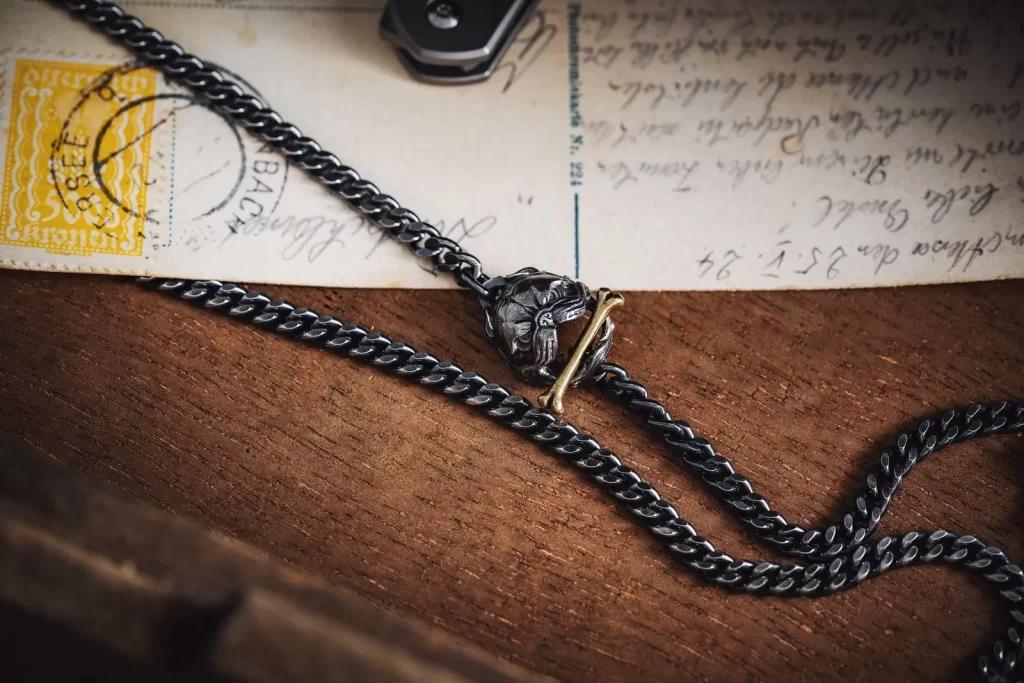
The Cuban link belongs to the curb chain family. Curb chains are made of uniform links that are twisted so they lie flat when the chain is laid down. They have been made for centuries, in many cultures, for practical and decorative uses. What distinguishes the Cuban link is its rounder, thicker links and the tight way they interlock, creating a dense, rope-like look with a smooth surface.
Miami and the name “Cuban”
The name is generally linked to Miami, where a large Cuban community developed from the late 1950s onward. Accounts vary on exactly who first made or popularized the style, but by the 1970s heavy gold curb-style chains were strongly associated with Miami’s Cuban-American community and its jewelers. The style became a local signature, and the name “Cuban link” spread from there.
Miami’s jewelry district grew into one of the busiest in the United States, with many jewelers specializing in gold chains. The “Miami Cuban” name is still widely used for tightly linked, heavier versions of the style.
New York and the rise of hip-hop
In the late 1970s and 1980s, hip-hop emerged from New York and quickly developed a strong visual identity. Gold jewelry became one of its most powerful symbols. Thick gold chains, including rope chains and Cuban links, signaled success and self-made status. Artists and fans in New York and beyond wore heavy gold as a statement, and jewelers in districts such as Canal Street and the Diamond District supplied them.
By the 1990s and 2000s, Cuban links had become one of the defining pieces of hip-hop jewelry. They appeared on album covers, in music videos and in countless photographs. Over time, iced-out versions set with diamonds pushed the style even further.
From subculture to mainstream
As hip-hop became global popular culture, so did its style. Cuban links moved from niche jewelers into department stores, online marketplaces and fashion runways. Today they are worn by athletes, musicians, actors and everyday people around the world. Women’s fashion embraced the style too, from delicate fine Cubans to oversized chunky versions.
Why the style endures
- Strength: the dense, interlocking links make a sturdy chain.
- Comfort: the flat profile sits smoothly against the skin.
- Versatility: it works at every width, from 2mm to 20mm and beyond.
- Visibility: the polished links catch light and show off gold beautifully.
- Meaning: for many people, it represents achievement, heritage or personal style.
How Cuban links are made
Traditionally, Cuban links were handmade. A jeweler would draw gold into wire, wind it into rings, cut and link them, solder each joint, then twist and press the chain so the links lie flat. The final steps involved polishing and often diamond-cutting the edges for sparkle. Today, most Cuban links are machine-made in large factories, which makes them more affordable and consistent. Handmade Cubans are still produced by specialist jewelers and are valued for their craftsmanship.
Variations that developed
- Miami Cuban: tighter, thicker links and a heavier feel.
- Diamond-cut Cuban: faceted surfaces for extra sparkle.
- Iced Cuban: links set with diamonds or other stones.
- Prong-link Cuban: stones held by prongs within each link.
- Fine Cuban: slim, delicate versions for everyday and women’s wear.
A style with many stories
Like many cultural objects, the Cuban link’s history is partly told through communities, families and personal memory rather than formal records. Different jewelers and neighborhoods tell slightly different origin stories. What is clear is that the chain’s identity was shaped by immigrant craftsmanship, local pride and music culture, which is a large part of why it carries so much meaning today.
Wearing a piece of history
When you wear a Cuban link, you are wearing a style that has been passed through generations of jewelers and wearers. Whether you choose a fine everyday chain or a heavy statement piece, it connects to a long tradition of craftsmanship and self-expression.
The Cuban link in sport and fashion
Beyond music, athletes played a big part in spreading the style. Basketball, football and boxing stars wearing gold chains on the way to games and in interviews put Cuban links in front of huge audiences. Fashion followed: designers began reinterpreting the chain in oversized proportions, in mixed metals and as a women’s statement piece. Social media accelerated everything, turning chain sizes, finishes and iced designs into trends that can spread around the world in weeks.
Why the Cuban link is still evolving
The style keeps changing because new makers and wearers keep adding to it. Lab-grown diamonds and moissanite have made iced Cubans more accessible, stainless steel has opened the style to new budgets, and fine Cubans have become a staple of everyday women’s jewelry. Yet the basic design, rounded links twisted to lie flat, remains the same as it was decades ago, which is a sign of how well it was designed in the first place.
Frequently asked questions
Why is it called a Cuban link?
The name is widely associated with Miami’s Cuban-American community, where the style became popular in the 1970s.
Is a Cuban link the same as a curb chain?
It is a type of curb chain, but with rounder, thicker and more tightly interlocked links.
When did Cuban links become popular in hip-hop?
Gold chains became central to hip-hop style in the 1980s, and Cuban links grew especially prominent through the 1990s and 2000s.
Are Cuban links still made by hand?
Some are, by specialist jewelers. Most are now machine-made, which keeps prices accessible.
